
By analyzing Luba objects within their textual and contextual frameworks, this doctoral research aims to challenge the prevailing notion that limits Luba female materiality to mere expressions of beauty or vessels of spiritual significance. Instead, it seeks to emphasize the intricate relationship between female Luba objects and the corporeality of Luba women, including their roles within the gendered power dynamics of Luba traditions and societies. This entails delving into the nuanced evolution from the veneration of sacred female-shaped objects to the exploitation and desecration of Luba women’s bodies. To achieve this goal, female Luba arts will be situated within a broader network of the complex realm of Luba traditions, integrating archival materials, museum documentation, orature, popular histories and memory, and cultural and artistic expressions. This interdisciplinary approach seeks to challenge existing narratives by examining both the multifaceted roles of Luba women in cultural production and representations that shape power-based narratives. By critically engaging diverse sources (multimedia, audiovisual, material cultures, and orature) within diverse cultural and historical frameworks (colonial and postcolonial), this dissertation furthermore aims to uncover and elucidate the nuanced interplay between gender dynamics, polity, memory, and change in the making and mapping of an archeology of power(lessness) within Luba traditions.
Female Archaeologies of Power(lessness) in East-Central Africa: Polity, Memory, and Change in (post)colonial Luba Traditions
Dissertation Project at princeton university
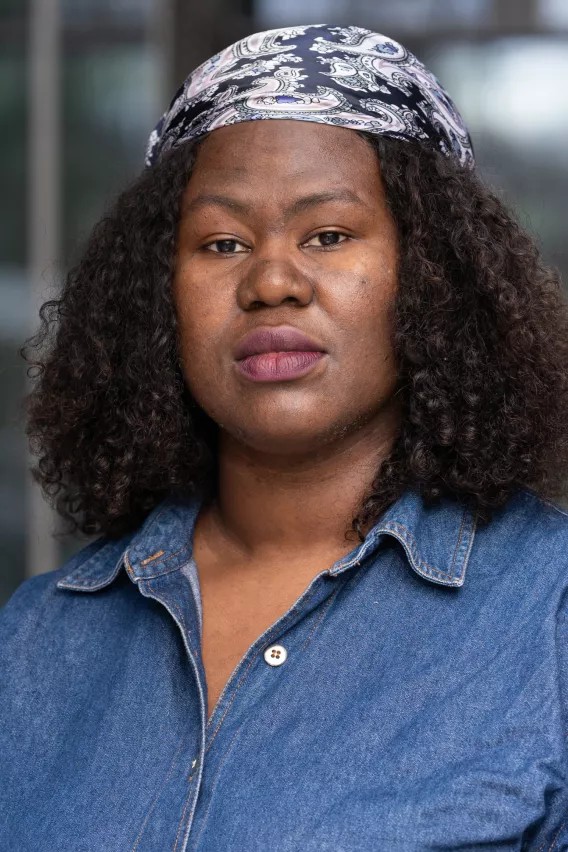
Candidate : Tiako Djomatchoua Murielle Sandra
Address the colonial disruptions that fractured traditional geographies, power networks, and narratives embedded in GLAM institutions (Galleries, Libraries, Archives, Museums) both within and beyond Africa. By challenging extractive practices, repatriating knowledge, and centering African epistemologies, we co-create ethical, community-driven frameworks that restore sovereignty over cultural memory and reweave the broken threads of history. By Reconnecting, we mean bridging colonial and postcolonial multimedia archives with living intangible traditions through the reassembly of fragmented material cultures, oral knowledge, and spiritual practices. We center female Luba institutions, keepers of memory, lineage, and ritual, as the guiding force in reclaiming, interpreting, and reactivating heritage, ensuring that reconnection is not only technical or archival, but deeply rooted in ancestral authority, gendered wisdom, and community sovereignty.
Luba Heritages Connect
What is developed here is a single, continuous framework that moves from how power is made visible to how power actually operates. It begins with optical elements that treat archives and knowledge systems as instruments of vision and distortion, adds quantum logics to explain why relational authority appears only at thresholds as fragmented traces, integrates ecological reasoning to account for how power persists and relocates under constraint, and culminates in a set of rhizomatic states that trace authority beyond sex and gender, not as identity, but as movement, stabilization, capture, translation, spatialization, storage, and analytic re‑centering.


LHC
ECO-OPTICAL FRAMEWORK: AN OVERVIEW
The Eco‑Optical Framework: An Overview
The eco‑optical framework is an analytic approach for understanding how power becomes visible, distorted, or erased within archives and knowledge systems. Rather than treating archives as neutral repositories, it approaches them as instruments of detection, systems that register certain forms of authority while structurally rendering others illegible. The framework develops incrementally. It draws first on optics to describe how visibility is engineered (what can be seen, what is filtered, what appears as shadow), then on quantum logics to explain why relational power often appears only as discrete events or traces rather than as continuous structures. It adds an ecological layer to account for how authority survives, relocates, and mutates under conditions of constraint. Eco‑optics is especially concerned with forms of power that operate beyond sex and gender binaries, relational, mobile, and infrastructural authorities that are frequently misread as absence, dependency, or symbolism. By shifting the question from “where is the power?” to “under what conditions does power become legible?”, the framework allows absence to be read as structured information rather than lack. Applied across historical archives, cultural memory, and contemporary AI‑mediated systems, the eco‑optical framework offers a portable method for diagnosing how knowledge infrastructures shape what counts as power, evidence, and history.
Dissertation Project
Main Focus
Archived Representations
Lived Experiences
ECO-OPTICAL FRAMEWORK

DISSERTATION
Female Archeologies of Power(lessness) in East-Central Africa: Polity, Memory, and Change in (post)Colonial Luba Traditions
Female archeologies of power and powerlessness name a single analytic field in which power is not absent but rendered legible as weakness through archival, legal, spatial, and epistemic capture. Powerlessness is treated not as a condition women inhabit, but as a form of power that is forced to take once authority is displaced into care, custom, morality, symbolism, or the social. Read archaeologically, these formations reveal how female authority persists, rerouted, compressed, delayed, or translated, while appearing marginal or invisible, allowing power and powerlessness to be understood not as opposites, but as historically co‑produced effects of constraint.
Female archeologies of powerlessness (biocultural sex)
Female archeologies of powerlessness (biocultural sex) treat “female” as a diagnostic surface where authority is forced to register through biology, care, morality, custom, and dependency. Here, power is not absent but converted into legible forms that institutions can manage, appearing as weakness, tradition, or social function. Biocultural sex names this zone of capture, where authority is compressed into the body and its norms, allowing power to be seen only at the moment it is being reduced.
Female archeologies of power (rhizomatic sex)
Female archeologies of power (rhizomatic sex) shift from diagnosis to operation by tracing authority once it exceeds sex and gender as explanations. Rhizomatic sex follows power as movement, circulating through roles without office, infrastructures of everyday life, spatial routes, symbolic storage, and delayed activation, where legitimacy and enforceability persist without visibility. Here, power is not recovered as identity but mapped as circulation, endurance, and reconfiguration, revealing how authority continues to act after it has been named powerless.

Dissertation
Find below an overview of the dissertation I built! A teaser to my upcoming defense!
Chapter 1
Introduces the problem of women’s archival “absence” as a structured effect of legibility rather than evidentiary lack and situates the eco‑optical framework as the project’s central analytic intervention.
Chapter 2
Reconceptualizes archives as instruments of vision that actively produce visibility, distortion, and shadow, establishing absence as an optical effect rather than a historical void.
Chapter 3
Explains why relational authority appears only intermittently in archives by theorizing power as registered at thresholds rather than as continuous structure.
Chapter 4
Formalizes optical and quantum concepts into analytic operators that specify how relations are detected, collapsed into categories, and stabilized as fact.
Chapter 5
Shows how colonial borders, mapping practices, and jurisdictional regimes refract circulatory authority into territorial residue and administrative fragments.
Chapter 6
Analyzes how legal codification converts relational female authority into governable categories that appear as dependency, tradition, or exception.
Chapter 7
Demonstrates how ethnic containerization obscures transregional female networks by forcing fluid polities into fixed cultural units.
Chapter 8
Rebuilds Luba political coherence without reimposing bounded ethnicity by tracing relational infrastructures rather than centralized sovereignty.
Chapter 9
Treats sex not as identity or explanation but as a surface where archival distortion becomes legible.
Chapter 10
Develops the concept of female archeologies of powerlessness as a diagnostic for how authority is systematically made to appear as absence.
Chapter 11
Introduces rhizomatic sex as an operational method for tracing power in motion beyond sex/gender binaries and identity‑based explanations.
Chapter 12
Accounts for how female authority survives, relocates, and mutates under constraint through ecological modes of endurance.
Chapter 13
Redefines polity as an architecture of enforceability rather than office, showing how authority binds without centralized command.
Chapter 14
Reconceptualizes memory as a competing governance medium that carries authority across rupture rather than correcting archival absence.
Chapter 15
Positions memory as the hinge connecting deep political time to contemporary knowledge systems, including creative industries and AI‑mediated archives.
Chapter 16
Examines digital humanities methods and research workflows as eco‑optical systems operating under constraint, showing how digitization, metadata, automation, and AI can reproduce, smooth, or reconfigure archival legibility rather than resolve absence.
Conclusions
This dissertation shows how authority can be continuous, operative, and causally effective while remaining structurally unreadable. Read together, the chapters demonstrate that moving beyond sex and gender is not a theoretical gesture but an analytic necessity for understanding how power survives, circulates, and is reconfigured across archives, memory, and contemporary digital workflows operating under constraint.
Digital Humanities Aspect of my Dissertation
The DH workflow developed in this project treats digital humanities not as a solution to archival absence, but as a knowledge pipeline operating under constraint. It moves from collection and digitization to metadata design, annotation, modeling, and circulation, while explicitly diagnosing how each step filters, compresses, or distorts relational power. Rather than aiming for total recovery or completeness, the workflow foregrounds limits—what can be registered, what is smoothed away, and what survives as trace—so that digitization, automation, and AI are read as eco‑optical systems that shape legibility. The goal is not to make power fully visible, but to build methods that remain accountable to distortion, endurance, and misrecognition within contemporary digital infrastructures.
Get in touch with us!
Have a question or want to learn more about this dissertation project? Tiako Djomatchoua Murielle Sandra is dedicated to providing excellent service to discuss any aspect of her ongoing research. Whether you prefer to contact us by phone, email, or in person, contact her directly by filling the form below.
This play emerges from my dissertation, which intervenes in debates across archival theory, feminist historiography, colonial classification, and contemporary AI governance. It asks how political memory and institutional force persist once visibility, categorical stability, and representational transparency can no longer be assumed.
eco-opticalplaypoem_full.pdf
Download